All human beings need to be seen, heard, and recognized. Unfortunately, when this is not forthcoming, one’s mental health can be deeply affected. I will be exploring how black and brown minority groups in the United Kingdom have been deeply affected by a lack of acknowledgement and inclusion. I have been observing and drawing parallels between my personal experiences as a black woman (who is British and recently moved to London) and those of other black Britons.
When I began my observations, I decided to follow the autoethnographic research approach and linked my own personal experiences that connect to the cultural context of London, social, and political to my data collection. I conducted my observations at different settings around the city of London; however, for this essay I will focus on three locations: Victoria and Albert Museum in South Kensington, The Tate Modern Museum and Waterloo Station in Central London.
Coming from an Afro-Caribbean and African background, my parents taught me from an early age to aspire to come to the United Kingdom to have better prospects. In most Commonwealth households, there is a strong influence of the British structure of existence. The UK was seen as the “mother country” and a beacon of hope. As a result of these ideals being drilled into my head every day since I was a little girl, I was very excited when I finally decided to move to the UK.
Waterloo Station
My mother (who is of Jamaican descent) told me stories she heard from her parents when she was a little girl of how the first post – war migrants from the Caribbean were invited to the UK to help rebuild after World War 2 in the 1930s and 1940s. Some of these West Indian migrants came on the HMT Empire Windrush, and the Windrush's arrival has become symbolic of the generation of Commonwealth citizens who came to live in the United Kingdom between 1948 and 1971.
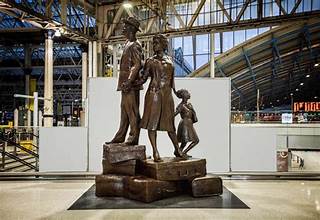
So, when I was told that I would be doing observations in my Observations and the Everyday course, I was so thrilled and decided to visit the Windrush monument at Waterloo Station, which was commissioned by Prince William, the Duke of Cambridge, on 22nd June 2022. When I arrived at the monument, I was immersed in the majestic bronze sculpture by Basil Watson. He had done a marvellous job and really brought out the essence of the Windrush generation and the anticipation that they brought along with them on their voyage to the “new world”.
I knew that where the monument is situated, it is in a very chaotic environment; however, in the field I noticed that no one even glanced at the statue; It was like it wasn’t even there.
I found it quite ironic that, just like Caribbean migrants (and their descendants) from the Windrush generation and their contributions have been constantly ignored, just like this magnificent statue. It’s as if other British subjects do not want to come face to face with the dilemma of dealing with past histories of violence and oppression.
‘Guiltiness rests on their conscious
Oh yeah
Oh yeah
And they live a life of false pretence every day
Each and everyday
These are the big fish who always try to eat down the small fish…’
(Bob Marley, ‘Guiltiness’ taken from the album Exodus 1977)
Tina Campt, a black feminist theorist of visual culture and contemporary art, speaks on the black gaze. Campt (2021) states that, “The gaze forces viewers to engage Blackness from a different and discomforting vantage point…But while contemporary, Black-produced popular culture brings broader visibility to Black life and history, more often than not its emphasis centres on the depiction of Black people and communities, while maintaining existing limitations of traditional ways of narrating the Black experience.”
While Blackness is now seen (i.e., made visible to a wider audience), it is not necessarily something to be felt. Much too often, Black life is rendered in ways that allow it to be engaged at a safe distance or viewed at arm’s length through a lens of pity, sympathy, or concern. It is a temporary point of connection, visited and left behind in the face of an inevitable return to the comfort and comforting perspective of self and “home”.
To me, this monument symbolises the destabilization of colonial views and societal norms; Race and racialisation seem to affect forms of observation.
Windrush
by
T. O. Yalaju
We came to build the ‘Motherland’ with a great invitation
But some looked at us with great speculation
We left the sunshine with great happiness
But came to the cold and met great dreariness
No turning back for us; the tide was set
Mama said, “You have to make it work or turn back with regret”.
We toiled and toiled and toiled with great persistence
And never once complained about the great resistance
They put up statues to ‘honour’ our service
But still scurry past us like we are a menace
Even as bronze statues, we are still a danger
When will we ever not be seen as strangers
Mama said, “You have to make it work or turn back with regret”.
I say, “I have made it, Mama, but I still feel beaten by regret”.
I was deeply saddened to learn that despite the devotion and confidence that many members of the Windrush community had for their colonial masters, in 2018 many descendants were forced to leave under then Prime Minister Theresa May’s government. Many were wrongfully imprisoned, denied legal rights and threatened with expulsion.
All human beings need to be seen, heard and recognized. Unfortunately, many black and brown Britons are still being misunderstood, misrepresented and voiceless in many areas of British society. However, despite Black Britons not being seen or heard in certain instances, they have managed to find creative ways of communicating their own narrative on what it means and feels to be black and British.TheTJournals